The Cycle of Heroic Action: Why Organizations Stay Busy but Don’t Improve

Heroic teams look high-performing on the surface, but interim fixes quietly drain capacity and fuel the next crisis. Here’s how to break the cycle.

In most organizations, work is seldom designed—it evolves in response to performance gaps exposed by growth and change. Under pressure for time and results, leaders will often respond with local improvements that do little to improve overall performance.

Leaders introduce interim solutions to close critical gaps, develop workarounds to manage problems, and even layer automation on top to streamline work. But unless the underlying causes of the performance gaps and problems are addressed, new problems will continually arise as an organization grows and changes. And each time a problem appears, teams will step in to solve it—reinforcing the heroic cycle.

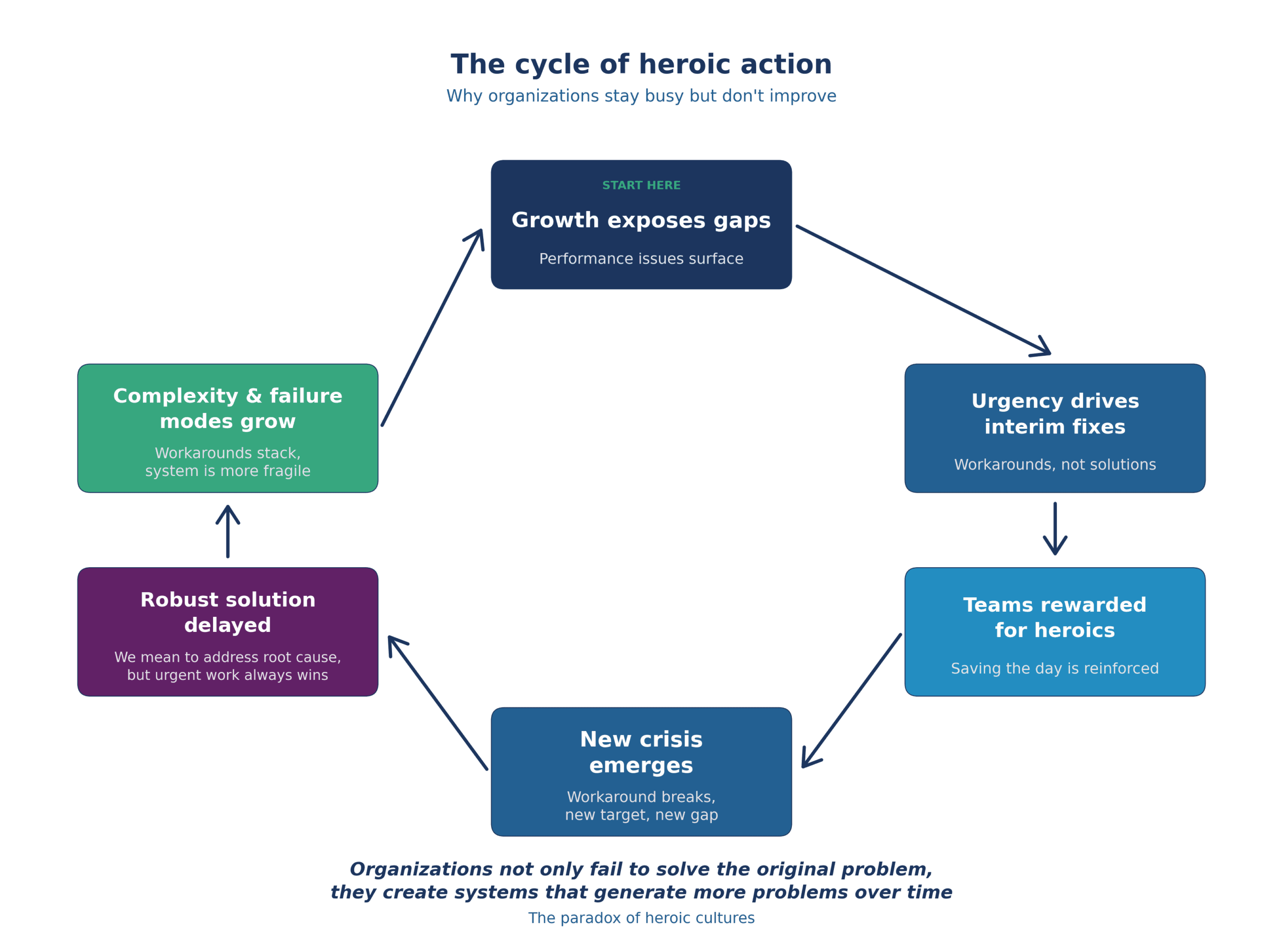
This pattern is called the Cycle of Heroic Action.

  1. Growth exposes gaps
  2. Urgency drives interim fixes
  3. Teams are rewarded for heroics
  4. A new crisis emerges
  5. Robust solution is delayed
  6. Complexity & failure modes grow


And the cycle repeats.
Over time, this produces increasingly complicated work processes to accomplish even the simplest tasks. Processes begin to resemble a Rube Goldberg machine—functional, even impressive in their ingenuity, but confusing to customers, inefficient for employees, difficult to scale, and prone to breaking when conditions change.

When Interim Becomes Permanent

There’s nothing wrong with making temporary fixes in the moment. Responsiveness and agility are healthy actions. The problem is what happens when interim solutions accumulate and remain in place longer than intended.

Each workaround layers onto the last. Manual steps compensate for system gaps. Extra approvals reduce risk created by unclear processes. Side spreadsheets track what core systems cannot. Informal communication fills structural voids. Each layer is intended to solve a problem—but together, they increase complexity and the likelihood of failure.

Eventually, even simple tasks require complex coordination. As a result, customers experience friction, employees become frustrated, and leaders feel stuck.

The Hidden Cost of the Cycle of Heroic Action

The most damaging aspect of the Cycle of Heroic Action is not any single crisis—it is the cumulative cost of operating in permanent emergency mode.

Organizations in this pattern don’t just struggle with efficiency. They struggle with consistency. Because work is held together by individual heroics rather than reliable systems, outcomes vary depending on who is involved and how much effort they apply.

Over time, increasing amounts of capacity are consumed simply to keep the system running.

As capacity gets constrained, other consequences begin appearing:

  • Burnout from sustained urgency
  • Inconsistent customer experience
  • Reduced scalability as complexity grows
  • Increasing resistance to change as systems become fragile

The organization becomes busy rather than effective.

This cumulative loss of capacity creates the very pressure that fuels the next round of interim solutions—and the Cycle of Heroic Action continues.

Breaking the Cycle of Heroic Action

Breaking the Cycle of Heroic Action is a leadership task requiring changes in execution of organizational strategy.

Here are four practical guidelines:

1. Set the Direction

Not everything can be a priority. Leaders must define clear performance targets aligned to customer needs and organizational capability, ensuring resources are aligned to deliver value.

  • Link daily work to strategic priorities
  • Align resources to demand
  • Set clear, measurable goals
  • Monitor performance and remove barriers

2. Design Work on Purpose

Build and maintain standard workflows that capture operational knowledge and provide visibility into how work is performed. Treat processes as managed assets.

  • Establish process design and knowledge management capability
  • Create cross-functional governance
  • Provide ongoing training
  • Implement performance measurement and feedback loops

3. Build Disciplined Execution

Establish operating rhythms that create visibility, enable early problem detection, and support rapid resolution before issues escalate into crises.

  • Create daily, weekly, and monthly operating cadences
  • Use visual management to make performance visible
  • Establish escalation paths and response protocols
  • Build problem-solving capability at all levels

4. Reward Consistent Performance

Recognize and reinforce behaviors that sustain performance over time—not just those that rescue it.

  • Set clear expectations
  • Provide continuous feedback
  • Align incentives to desired behaviors
  • Lead with accountability

When put into practice, this shift produces a different kind of culture—one that improves efficiency, reduces operational waste, and strengthens employee engagement by empowering employees to identify and solve problems.

The result is higher quality, faster delivery, and improved profitability. It creates a safe, collaborative environment focused on continuous improvement and delivering greater value to customers.

Sustainable Performance Wins

Organizations that learn to surface problems early, collaborate across functions, and implement durable solutions gain a competitive advantage over those that continue to manage heroics. They respond faster—not because they are in crisis—but because their systems are clear.

They also scale more easily because complexity has not hardened into infrastructure. Their teams are energized and enthused rather than exhausted and complacent.

In the long run, organizations that simplify work and close gaps while they are still small will outperform those that rely on heroic effort to survive.

The goal is not fewer committed people.

The goal is systems that no longer require heroics.

The Test That Reveals the Problem Immediately

The clearest diagnostic for whether a change initiative has the right balance between communication and process work is a single question: ask a frontline employee in the most impacted role to walk you through their first three actions on the morning of go-live. If they cannot do it – if the answer contains any version of “I think,” “I’m not sure,” or “I’ll wait and see what others do” – the process work is not done. It does not matter how many communications have been sent, how high the training completion rate is, or how many town halls the executive sponsor attended. The work is not done.

Most organizations measure what is easy to count. Email open rates. Town hall attendance. Training completion percentages. These metrics confirm that the communication reached people. They say nothing about whether people understand what to do or have the confidence and capability to do it. The gap between those two things is where initiatives die.

There is also a sequencing problem. Most communication plans front-load the what and why – the vision, the strategic rationale, the urgency – and deliver the how closest to go-live, when there is the least time for it to be absorbed and practiced. This is the reverse of what a frontline employee needs. They can tolerate uncertainty about the strategic reasoning for a change. They cannot function effectively without clarity on the specific actions the change requires of them.

How This Failure Appears Across Industries

In lean six sigma consulting and lean transformation consulting work, this failure pattern is endemic to improvement initiatives that treat lean as a change communication program rather than a method for redesigning how work is performed. A value stream mapping consulting engagement or kaizen event produces a detailed future-state map. The communications go out. Leadership endorses the outcomes. Thirty days later, the floor is running the old process – not because of resistance, but because the future-state map describes what the process should look like at a system level without telling the operator, the supervisor, and the quality technician what they specifically do differently, in what sequence, starting when.

In healthcare consulting engagements, the process clarity failure carries compounded stakes. A redesigned clinical protocol or care coordination workflow that is communicated as an organizational change without role-specific process documentation leaves nurses, care coordinators, and clinicians reconstructing the how on their own. In a healthcare setting, that ambiguity creates patient safety risk, not just productivity loss. The communications confirm awareness. The absence of operational specificity creates execution variance.

In packaging manufacturing consulting, the failure appears in changeover programs, line balancing initiatives, and quality system deployments where the new process is documented at the workflow level but never translated into the specific daily sequence of actions for each role. The standard operating procedure is updated. The training is completed. The floor operates based on a combination of the new SOP, the old habits, and each operator’s individual interpretation of the gap between them.

In operational excellence consulting work more broadly, the pattern is consistent: the further the process documentation sits from the point of execution, the larger the gap between what the initiative intended and what actually happens on the floor. Closing that gap requires process artifacts – role-specific job aids, updated SOPs validated by the people who perform the work, workflow diagrams that reflect the actual sequence – not additional communications telling people why the change matters.

The Communication-to-Process Ratio

One of the most useful diagnostics in process improvement consulting work is what we call the Communication-to-Process Ratio Audit. For every communication that tells employees what is changing, there should be a corresponding artifact that shows them how to do it – an updated SOP, a role-specific job aid, a workflow diagram, a quick-reference guide, or a training module built around the specific process steps. Not the initiative’s rationale. The steps.

If planned communications outnumber process artifacts at a ratio of 3:1 or higher, the initiative is over-indexed on messaging and under-resourced on operational support. That ratio is not a precise threshold – it is a forcing function for an honest internal conversation about where the team’s effort has actually gone.

The minimum process artifacts required before any go-live are: updated SOPs validated by the people who will use them; role-specific workflow documentation that reflects actual job responsibilities, not the generic process; explicit escalation paths for when something does not work as expected; and defined support resources for the first thirty days post-launch. If any of these are missing, the go-live date should move. Launching into a readiness gap is not a calculated risk. It is a predictable contribution to the seventy percent.

The Cumulative Load Problem

Rarely does a single initiative create unbearable change fatigue on its own. What creates it is accumulation – five initiatives running simultaneously across the same employee populations, each with its own communication cadence, each competing for the same working hours, each asking for behavioral changes that are individually reasonable but collectively impossible to sustain without a clear view of total demand.

Most organizations cannot see this problem because change initiatives are managed in silos. Each project team sees its own work. No one is looking across the portfolio at what is simultaneously being asked of the same group of people. In operational excellence programs running multiple lean transformation consulting workstreams in parallel, this is particularly acute: the kaizen pipeline generates a steady stream of improvement actions without any coordinated view of cumulative human capacity.

The Change Portfolio Heat Map addresses this directly – not as a project management tool but as a capacity planning tool for people. It maps all active change initiatives against the employee populations they affect, surfaces the overlap and timing conflicts that are invisible when initiatives are managed independently, and produces the information needed to make honest sequencing decisions. Sometimes the most valuable action a change team can take is to delay a well-designed initiative by sixty days to give an earlier program time to stabilize. The heat map makes that case in language that leadership can act on.

What Employees Actually Need: The Stop List

The single most operationally useful communication for an employee whose workflow has changed is not the executive video or the culture manifesto. It is a clear, role-specific answer to the question they are actually asking: what do I do differently, and what do I stop doing?

The Start / Stop / Continue framework provides this. For each impacted role: what the employee should Start doing that they do not do today; what they should Stop doing that is no longer part of the process; and what they should Continue because it has not changed. Simple. Role-specific. Delivered at or immediately before go-live.

The Stop list is the element most consistently omitted, and its absence is costly. When employees are not told explicitly what to stop, they continue doing it alongside the new behaviors. The result is redundant effort, data inconsistency, and – in regulated environments like healthcare, food and beverage, or pharmaceutical manufacturing – compliance exposure. Producing a clear, role-specific Stop list is one of the highest-value, lowest-cost actions a change team can take. It costs almost nothing to produce. Its absence costs far more.

Share this article

Facebook
LinkedIn
X
Email