
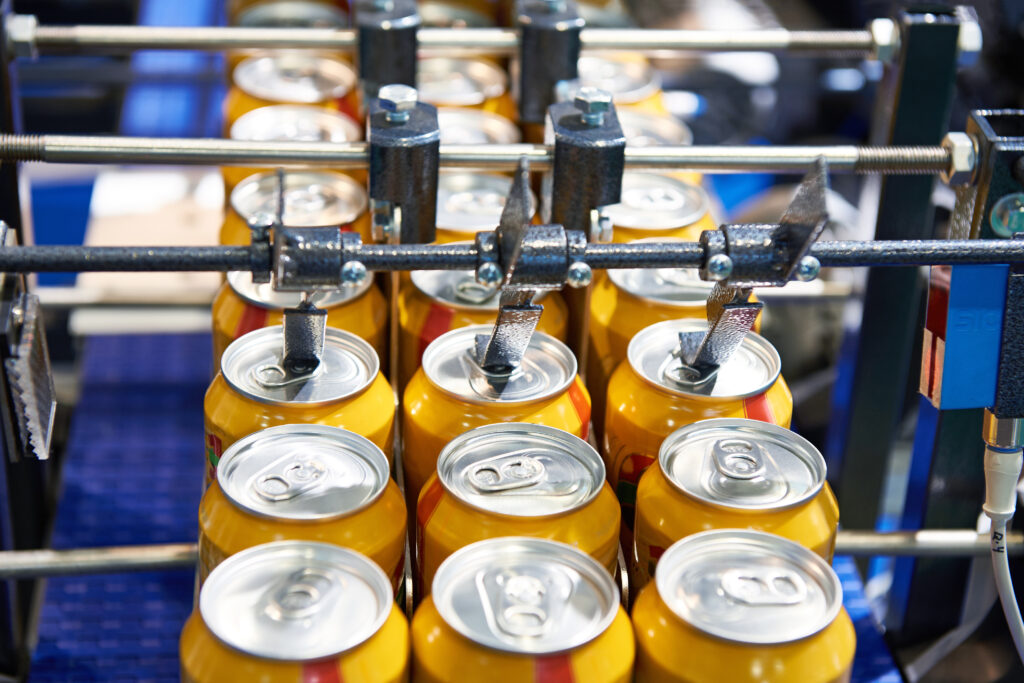
This engagement focused on stabilizing manufacturing efficiency by aligning shop order sizes with true economic drivers. By integrating manufacturing and supply chain decision-making, the organization improved throughput, reduced variability, and established a more disciplined planning model.
Increase in Production
Net Operational Cost Savings
Gross Savings
A leading beverage manufacturer struggled with inconsistent case fill rates and sub-optimization between manufacturing and supply chain operations. Operational efficiency fluctuated significantly, ranging from 62 percent at its best to as low as 53 percent, driven largely by inconsistent shop order sizes and frequent changeovers.
These inefficiencies created instability in production schedules and made it difficult for teams to sustain performance. Leadership engaged Adonis Partners to determine how order quantities could be optimized to improve efficiency while balancing manufacturing and supply chain tradeoffs.
Adonis Partners began with a detailed diagnostic of existing data and planning practices, working closely with a cross-functional team spanning manufacturing and supply chain. Together, the team developed an optimal manufacturing order quantity model at the SKU level.
The model incorporated key economic drivers, including changeover costs, labor requirements, carrying costs, and cost of capital. Safety stock levels were integrated into the analysis, and historical criteria for minimum order quantities were reevaluated to ensure planning decisions reflected actual operational and financial impacts.
This data-driven approach aligned manufacturing and supply chain teams around a shared set of decision rules.
Implementation of the optimal order quantity model delivered measurable improvements. Production throughput increased by 11 percent, generating a net savings of $38,000. These savings included $36.9k related to incremental changeover costs, $53.5k in storage savings, and $21.1k from reduced carrying costs.
Beyond the financial results, the optimized process stabilized operational efficiency and reduced variability in production schedules. Improved coordination between manufacturing and supply chain teams delivered immediate benefits and established a foundation for sustained process excellence.
We help leadership teams identify where performance is constrained and what it takes to unlock results. Share a few details and we’ll explore whether a similar approach makes sense for your organization.
Beverage Manufacturer
Scale: $154M Annual Revenue
✓ Generated $38k in net operational cost savings
✓ Engineered a tailored SKU-based order quantity model
✓ Grew production throughput by 11%